Blog
Quote-to-Cash Gaps Wholesale Distributors Still Have
Wholesale distributors lose margin and delay cash when quotes, orders, inventory, fulfillment, invoices, and payments remain disconnected. Here is where the gaps occur and how to close them.
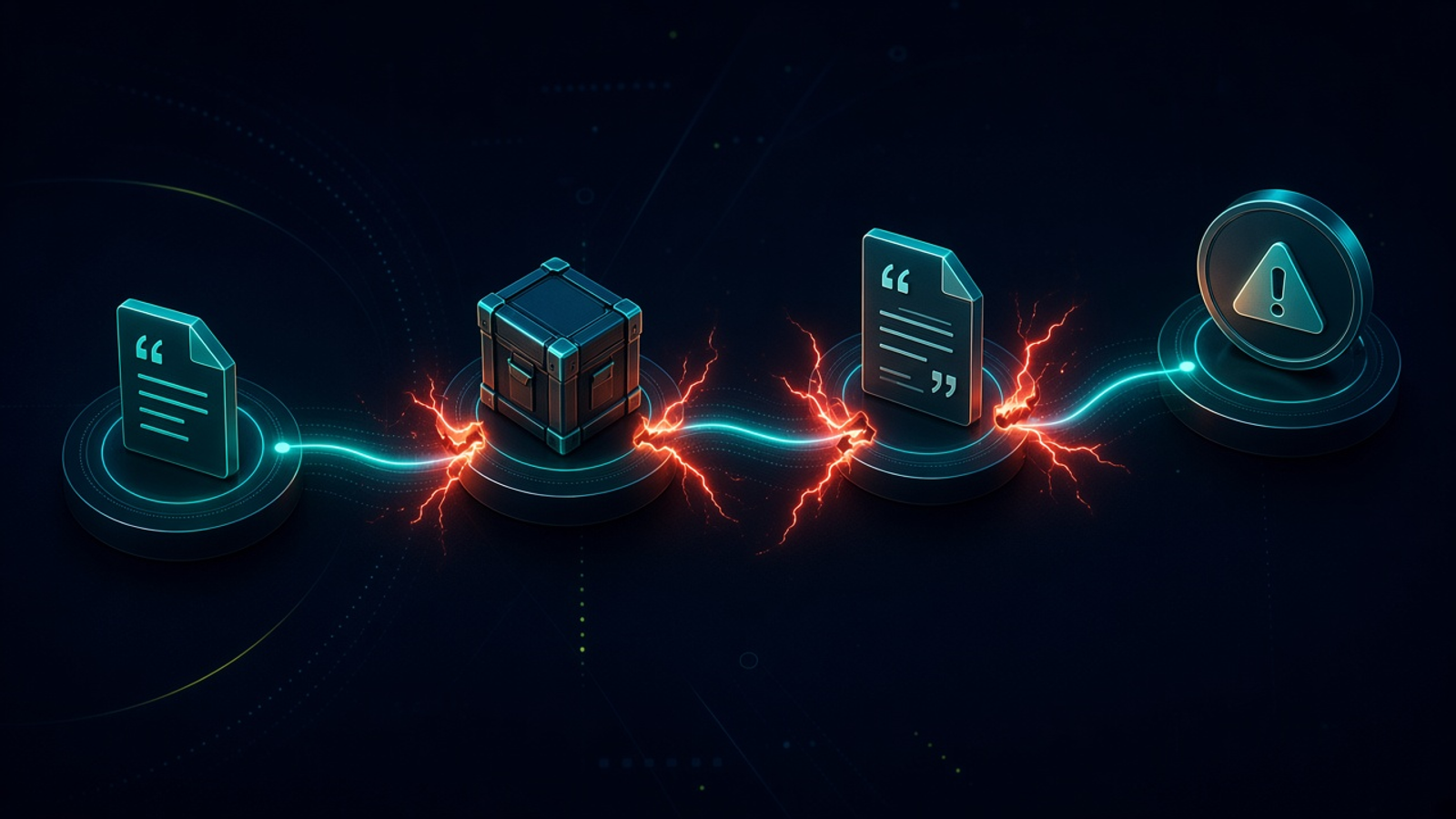
Quote-to-Cash Gaps Wholesale Distributors Still Have. Written by Adeem Adil Khatri at Zaps Studio.
TL;DR
- Fixed-price automations that pay for themselves in weeks, not quarters.
- Lead routing, quote follow-ups, and recovery flows with real ROI numbers.
- You own the system — no retainer lock-in to keep it running.
Wholesale distributors rarely lose cash because they cannot produce a PDF quote. They lose it in the handoffs after quoting: stale prices, missing stock data, re-keyed orders, partial shipments, delayed invoices, and unpaid exceptions. The fix is a traceable workflow from quote to order, fulfillment, invoice, ledger, and receipt—not another isolated quoting tool.
Where do wholesale distributors lose control between quote and cash?
The most expensive gaps usually appear between systems and teams:
Customer pricing: Contract prices, volume breaks, rebates, and credit terms may live in spreadsheets, inboxes, CRM notes, or ERP records.
Availability: Sales teams quote from stale stock data, then discover backorders or higher replacement costs after customer acceptance.
Order entry: Accepted quotes are manually re-entered into an ERP, warehouse system, or supplier portal.
Fulfillment: Partial shipments, substitutions, backorders, and delivery exceptions are not consistently pushed back to sales or customers.
Invoicing: Billing waits for shipment confirmation, proof of delivery, or someone to reconcile a changed order.
Collections: Payment reminders are sent from a separate process with little context about disputes, credits, or missing documents.
This is why quote-to-cash should be measured as one operational chain. A quote that closes quickly but creates a two-day order-entry delay has not improved the commercial process.
QuoteWerks illustrates the target state for part of that chain: its distributor integrations can retrieve live pricing and availability, convert accepted quotes into purchase orders, and track supported fulfillment details. The limitation is equally important: coverage depends on supported vendors, editions, regions, and integrations, so it does not automatically replace every ERP, accounting, or collections workflow.
What are the five most common quote-to-cash gaps?
1. Customer-specific pricing is not validated at quote time
Distributors often sell the same product at different prices based on account, contract, quantity, territory, or negotiated terms. If the quoting layer does not validate those rules against a reliable source, sales can create:
Underpriced quotes that damage gross margin
Overpriced quotes that reduce win rates
Quotes using expired promotions
Incorrect freight, tax, or surcharge assumptions
Orders that require manual approval after acceptance
The practical control is a pricing check before the quote leaves the business. The workflow should identify the customer, price list, quantity break, currency, tax treatment, and approval threshold, then flag exceptions rather than silently passing them downstream.
2. Availability is treated as a static field
Inventory is not simply “in stock” or “out of stock.” A distributor may need to account for:
Multiple warehouses
Reserved inventory
Supplier availability
Lead times
Substitutions
Minimum order quantities
Backorders
Split shipments
A quote that promises ten units from the wrong warehouse can create an avoidable service failure. QuoteWerks’ documented workflow shows why real-time pricing and stock availability matter: users can compare supported distributor sources before placing an order. The limitation is that unsupported vendors may still require manual entry, imports, or separate procurement steps.
3. The accepted quote does not become an executable order
This is often the central quote-to-cash gap. A customer accepts a quote, but the team still has to:
- Copy customer and ship-to details into the ERP.
- Re-enter product codes and quantities.
- Recalculate discounts and tax.
- Check credit status.
- Create a sales order or purchase order.
- Notify procurement or the warehouse.
- Confirm the delivery promise.
Every manual field is an opportunity for a mismatch. The safer design is to treat acceptance as a controlled event. It should create a draft order, validate required fields, run approval rules, and route only exceptions to a person.
4. Fulfillment changes do not reach billing
A shipment can differ from the original quote because of a substitution, short shipment, split delivery, freight adjustment, or customer-approved change. If the invoice is created from the original quote rather than the fulfilled order, disputes become predictable.
A connected process should record:
What was quoted
What was ordered
What was allocated
What was shipped
What remains open
What can be invoiced
What the customer has paid
That record also helps customer service answer “Where is my order?” without asking the warehouse to reconstruct events from email threads.
5. Collections starts without operational context
An overdue invoice may reflect a genuine payment delay, but it may also reflect:
Missing proof of delivery
An unresolved short shipment
A pricing discrepancy
A credit memo waiting for approval
An invoice sent to the wrong contact
A purchase-order mismatch
Automating reminders without identifying these exceptions can make collections noisier rather than more effective. The workflow should classify invoice status, shipment status, dispute reason, account owner, and next action before sending a reminder.
How should a distributor map its quote-to-cash workflow?
Use a simple event map before buying or building automation:
- Capture the quote: Record customer, products, quantities, pricing source, margin, delivery promise, and expiry date.
- Validate commercial rules: Check customer-specific pricing, credit terms, tax, discount limits, and required approvals.
- Capture acceptance: Store the acceptance timestamp, approver, accepted version, and any customer amendments.
- Create the order: Transfer validated data into the ERP or order system without re-keying.
- Reserve or source stock: Check warehouse availability, supplier lead times, substitutions, and backorders.
- Confirm fulfillment: Track allocation, shipment, delivery, proof of delivery, and exceptions.
- Generate the invoice: Invoice the fulfilled quantity and approved adjustments, not merely the original quote.
- Post and reconcile: Push the invoice to accounting, match payments, and flag short payments or disputes.
- Close the loop: Update the CRM and customer record with revenue, margin, delivery outcome, and collection status.
At each step, ask three questions:
What system owns this data?
What event moves the process forward?
What exception stops automation and requires a person?
That map is usually more valuable than a long feature comparison. It shows whether the business needs a quoting product, ERP configuration, integration work, or a smaller workflow around existing systems.
What should distributors automate first?
Start with the handoffs that are frequent, rule-based, and expensive to correct.
First priority: accepted quote to order
This is usually the best starting point because it affects fulfillment, inventory, invoicing, and customer experience. Automate the transfer of approved customer, product, quantity, pricing, delivery, and tax data into a draft or confirmed order.
Keep human approval for:
Margin below threshold
Credit hold
Unusual discount
Non-standard payment terms
Missing stock
Large or high-risk orders
Second priority: shipment exception to customer update
Trigger an internal task or customer notification when an order is split, delayed, substituted, or partially fulfilled. The aim is not to send more messages; it is to prevent sales and service teams from discovering operational changes too late.
Third priority: invoice exception to collections task
Instead of sending every overdue account the same reminder, classify the reason and route it:
- No dispute: collections follow-up
- Missing proof of delivery: operations task
- Pricing dispute: account-owner task
- Credit memo pending: finance task
- Wrong billing contact: master-data task
Fourth priority: quote and order reporting
Create a single operational view of:
Quote-to-order conversion
Quote ageing
Order-entry cycle time
Gross-margin leakage
Backorder rate
Invoice delay
Exception volume
Days sales outstanding
Zaps Studio typically builds these customer-floor workflows in n8n, with the client retaining the source, credentials, and documentation. A focused workflow is generally $1,000–$3,000, while a connected system is commonly $3,000–$12,000; implementation complexity, data migration, and third-party systems can change the final scope. See the workflow automation cost guide and B2B n8n workflow examples for planning context.
How much do distributor quote-to-cash systems cost in 2026?
Public pricing is only a starting signal. The total cost usually includes software, implementation, integration, migration, training, support, and changes to ERP or accounting processes.
Useful 2026 planning bands include:
Lightweight wholesale ERP or accounting: roughly $25–$100 per month in public examples, before add-ons and implementation.
CRM or quoting layer: roughly $14–$88 per user per month in public examples, depending on product and tier.
Distribution ERP: around $600 or more per month in some public plans.
Implementation: about $900 at the low end for simple deployments, with complex integrations and migration priced separately.
Custom quote-to-cash systems: custom pricing is normal when the scope includes CPQ, ERP, warehouse, accounting, payment, and multi-entity requirements.
Zaps Studio workflow delivery: $1,000–$3,000 per workflow or $3,000–$12,000 per system, with retainers from $500 per month.
The right comparison is not subscription price alone. Calculate the cost of one failed order, one margin leak, one delayed invoice, and one avoidable collection dispute. Then compare that with the cost of removing the handoff that causes them.
Which alternatives should distributors consider?
QuoteWerks
Verdict: Strong for structured quoting, live distributor pricing, procurement, and quote-to-order handoff.
Suits: MSPs, technology resellers, and distributors working with supported vendor integrations.
Pricing signal: Public QuoteWerks Web plans include $50 per month and $78 per concurrent user per month tiers.
Limitation: It is primarily a quoting and procurement layer; accounting, collections, and unsupported-vendor workflows may still need separate systems.
Official product: QuoteWerks quoting and procurement
Wati
Verdict: Useful for WhatsApp-based customer communication and shared inbox workflows.
Suits: Teams that already use WhatsApp for order updates, support, or customer engagement.
Pricing signal: Public pricing varies by plan, messaging usage, and WhatsApp Business Platform charges.
Limitation: It does not replace distributor ERP, inventory control, order entry, or accounting.
Official product: Wati WhatsApp platform
Respond.io
Verdict: Good for consolidating conversations across messaging channels and routing customer interactions.
Suits: Customer-facing teams managing multiple channels and handoffs.
Pricing signal: Plans are subscription-based and scale by workspace capability and usage.
Limitation: An omnichannel inbox is not a complete quote-to-cash ledger or fulfillment system.
Official product: Respond.io omnichannel inbox
Zoho CRM
Verdict: A budget-conscious CRM automation layer for lead, account, and follow-up processes.
Suits: Smaller distributors that need structured CRM workflows before investing in a broader ERP program.
Pricing signal: Per-user subscription pricing varies by edition and billing term.
Limitation: Product availability, warehouse operations, purchasing, and accounting may require other Zoho products or integrations.
Official product: Zoho CRM automation
The decision depends on the missing link. If quoting is the bottleneck, evaluate QuoteWerks. If customer communication is the bottleneck, consider Wati or Respond.io. If the issue is a disconnected order, warehouse, invoice, or payment process, map the workflow before selecting another front-end tool.
How can Zaps Studio help close the gaps?
Zaps Studio works with operations-heavy SMBs where the problem is usually not a lack of software but a lack of reliable movement between software.
The delivery sequence is:
- Audit the current floor: Document quote, order, inventory, fulfillment, invoicing, and payment handoffs.
- Choose one measurable bottleneck: Start with accepted quote to order, shipment exceptions, or invoice follow-up.
- Build the workflow in the client’s accounts: Clients keep their n8n source, credentials, and documentation.
- Add exception handling: Route margin, stock, credit, delivery, and payment exceptions to named owners.
- Measure the outcome: Track cycle time, error rate, margin leakage, invoice delay, and outstanding exceptions.
- Expand only after proof: Connect the next handoff once the first workflow is stable.
Zaps Studio’s primary work includes AI voice agents and after-hours intake, followed by customer-floor n8n automations. For a distributor, that could mean capturing an urgent order or delivery issue after hours, routing it to the correct on-call person, and updating the operational record rather than leaving the request in voicemail.
Voice agents start at $500 setup and from $199 per month with 200 minutes included. They are built in the customer’s own accounts, so the customer retains the setup if the relationship ends. For workflow projects, delivery is typically two to four weeks after the audit.
Relevant starting points include the lead-routing automation guide, quote follow-up automation guide, and Zaps Studio pricing.
What should a distributor measure after automation?
A quote-to-cash project should produce operational evidence, not just a new integration diagram. Track:
Median time from quote acceptance to sales order
Percentage of orders created without re-keying
Pricing and quantity error rate
Gross-margin leakage from quote changes
Backorder and substitution rate
Shipment exception response time
Time from delivery confirmation to invoice
Invoice dispute rate
Payment-matching exception rate
Days sales outstanding
Number of manual touches per order
A useful first target is not “automate everything.” It is to remove one repeated re-entry step while preserving an audit trail and a clear human owner for exceptions.
The central question for quote-to-cash gaps for wholesale distributors is simple: where does accepted customer intent stop becoming executable operational data? Find that break, measure its cost, and automate the handoff before adding another disconnected tool.
Sources
QuoteWerks documents real-time distributor pricing, availability, procurement, fulfillment tracking, and accepted-quote-to-order workflows.
QuoteWerks lists public web pricing tiers including $50 per month and $78 per concurrent user per month.
Keep reading
Workflow automation cost guide
USD/GBP bands for DIY, freelancer, and fixed-price builds.
OpenFixed-price packages
One workflow from $1,000. You keep the n8n source.
Open10 n8n workflow examples
Lead routing, CRM revival, quote follow-up, ecommerce ops.
Open5 B2B automation quick wins
The live how-to that pairs with most of these drafts.
Open
FAQ
Ready to automate your workflows?
Book a free 30-minute audit. We'll analyze your current workflows and identify automation opportunities that pay for themselves in weeks.